

The condition in which dragées reach the customer depends partly on how they were manufactured and partly on how they are treated afterward. Once the product leaves the manufacturer, preserving its quality becomes a shared responsibility, from planning appropriate stock quantities to maintaining the right storage conditions and protecting the product during handling, repacking, and display.
Sugar-coated and chocolate-coated dragées are both sensitive products. Temperature and humidity affect their surfaces and structure, while exposure to light can progressively alter the colors of sugar coatings. Chocolate readily absorbs surrounding odors, and sugar-coated products can also pick up unwanted smells from their environment. Thin sugar shells require careful physical handling because scratching, chipping, or breakage can occur well before there is any deterioration in the product itself.
Good storage therefore means more than placing confectionery in a generally cool, dry room. The objective is to keep dragées as close as possible to the condition in which they left the manufacturer while avoiding unnecessary storage time and exposure.
Planning Stock Around Sell-Through
Appropriate stock levels begin with expected sell-through rather than available storage capacity. A professional buyer needs enough product to cover normal demand, replenishment time, and a reasonable safety margin without carrying quantities that are likely to remain in storage unnecessarily.
The balance will be different for every product. A core dark chocolate almond that sells throughout the year can support a different stock depth from a particular pearlescent wedding color or a product intended specifically for Christmas, Easter, or Ramadan/Eid. Customized colors, slow-moving finishes, and seasonal products generally justify more conservative quantities because their commercial relevance can decline long before there is anything technically wrong with the product.
A buyer’s own sales history is usually the best guide. A product selling 5 kg each week has a fundamentally different stock requirement from one selling the same quantity every two months. The objective is not to minimize inventory at all costs, but to avoid keeping products in storage simply because the business ordered more than it could reasonably sell.
This is particularly important with seasonal collections. Once an occasion has passed, perfectly sound stock can become commercially difficult to move. Sensible ordering therefore contributes directly to maintaining a fresher rotation of products.
Receiving and Rotating Stock
Every delivery should be checked before it is incorporated into existing stock. Outer cartons and inner packs should be intact, seals should not be compromised, and there should be no visible indication of moisture, heat exposure, or physical damage during transport.
Original product labels and their lot and date information should always remain available. Traceability is necessary regardless of whether several deliveries of the same product are currently in stock, and it becomes essential if a quality question later needs to be investigated. A product whose identifying information has been discarded is much more difficult to assess reliably.
Stock should then be arranged so that older appropriate lots are used first. New stock should never be placed in a way that pushes earlier stock to the back and makes it less likely to be picked. Where relevant date markings differ, the earliest applicable date should guide rotation; otherwise, first-in, first-out remains the basic principle.
A well-organized storage area makes this rotation natural. Employees should not have to search through several deliveries to determine which carton should be opened next.
Storage Temperature, Humidity, Light, and Odors
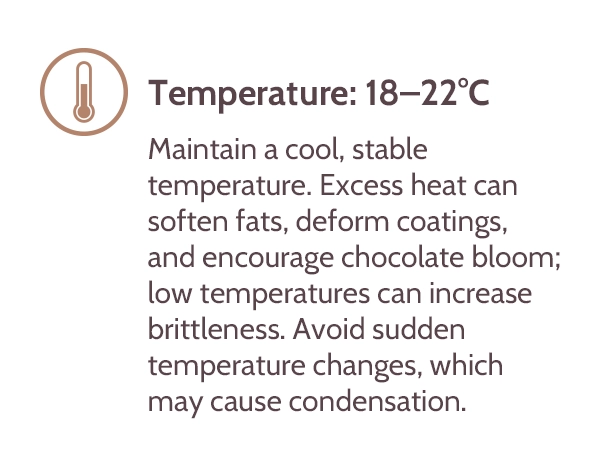
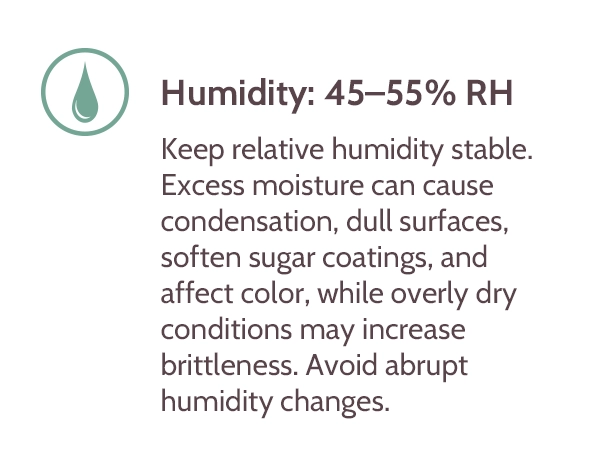
EL KAISSI recommends storing dragées at 18–22°C and 45–55% relative humidity, with the temperature kept as stable as possible.
Dragées should not be stored in ordinary refrigerators, and refrigeration is generally unsuitable for most chocolate products as a routine storage method. Colder does not automatically mean better preservation. The greatest problem often appears when a refrigerated product is brought back into a warmer environment: moisture can condense on the cold surface, affecting sugar shells and contributing to sugar bloom on chocolate. Professional chocolate guidance likewise cautions against cold, humid storage and against temperature shocks.1Callebaut. “Confectionery Shelf Life: Good Storage PracticesView source
If a product has nevertheless been held significantly below its normal storage temperature, it should be allowed to return gradually to the temperature of the room while still sealed. Opening a cold package immediately in warmer, more humid air can cause condensation directly on the dragées.
Temperature stability matters almost as much as the temperature itself. Products should therefore not be stored beside heaters, ovens, warm machinery, exterior walls that heat substantially during the day, or other sources of repeated temperature variation.
Colorants differ considerably in their stability and in their response to factors such as light, temperature, oxygen, pH, and the composition of the food system. Synthetic colors are generally more stable than natural alternatives, but individual colorants still differ in their resistance to these conditions.2Downham, A. & Collins, P. “Colouring our foods in the last and next millennium.” International Journal of Food Science & Technology, 35(1), 2000, 5-22. DOI: 10.1046/j.1365-2621.2000.00373.x.View source
For EL KAISSI’s sugar-coated dragées, light exposure is particularly important because it progressively affects color stability and homogeneity. The degree and speed of visible deterioration vary from one color to another, but the practical rule is straightforward: colored sugar-coated dragées should be protected from light. Longer exposure and greater light intensity generally make the deterioration apparent sooner.
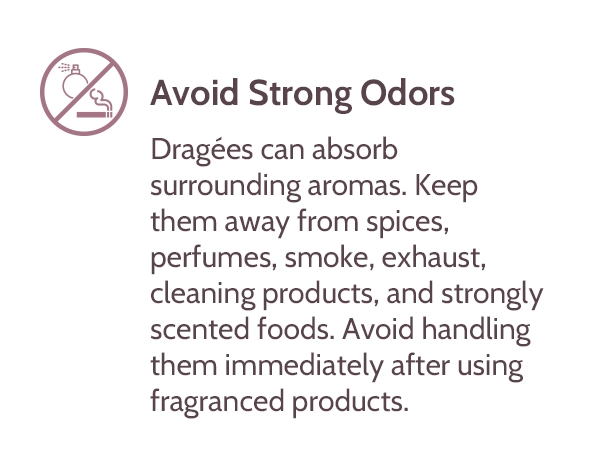
Odors are another reason to treat the storage environment carefully. Chocolate readily absorbs surrounding smells, which is why dragées should not be stored near perfumes, cleaning chemicals, spices, strongly scented foods, or other odor-producing materials.
Temperature and relative humidity should be measured rather than estimated from how comfortable the room feels. The storage area should also remain clean, dry, pest-controlled, and separated from chemicals and other possible contaminants.3FAO & WHO. General Principles of Food Hygiene. Codex Alimentarius Code of Practice CXC 1-1969, revised 2022. Rome, 2023View source
Direct drafts should be avoided as well. Products positioned immediately in front of an air-conditioning outlet can experience localized temperature changes that are different from the rest of the room. A draft-free location helps maintain a more stable product temperature and reduces the conditions that can lead to surface condensation when temperatures change.4Callebaut. “Confectionery Shelf Life: Good Storage PracticesView source

Handling Opened Bulk Packs
Products are best kept in their original sealed packaging until they are required for packing or display. Once a bulk pack is opened, the protection provided by that sealed environment is reduced, making good handling practices more important.
Only the working quantity needed should be exposed where practical, and the remaining product should be resealed promptly. If dragées need to be transferred from their original packaging, the working container should be food-grade, closed, airtight, odor-free, and protected from light. Stainless steel is particularly suitable for working stock because it is durable, non-absorbent, easy to clean, and does not introduce odors.5Callebaut. “Confectionery Shelf Life: Good Storage PracticesView source6FAO & WHO. General Principles of Food Hygiene. Codex Alimentarius Code of Practice CXC 1-1969, revised 2022. Rome, 2023View source
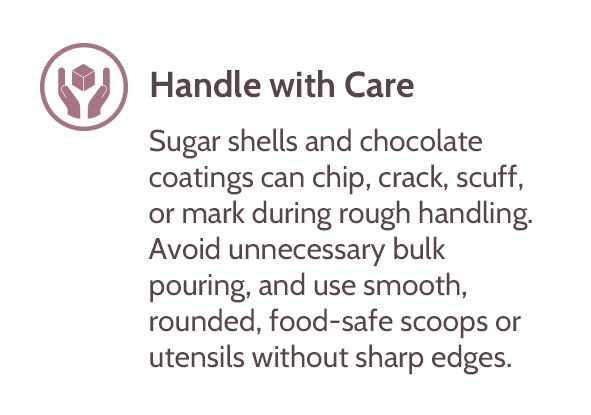
Physical handling can damage dragées long before storage conditions cause any other visible deterioration. Thin sugar shells can scratch, chip, or break, while chocolate-coated products can show minor surface marks very easily.
Glossy chocolate dragées are particularly unforgiving because even small scratches become visible against the reflective surface, and gloss gradually declines with prolonged exposure and handling. Dusted chocolate products present a different problem: with time and exposure to humidity, the powder can begin to adhere unevenly to the surface and lose the dry, distinct effect for which it was applied.
Utensils should therefore have smooth, rounded contact surfaces rather than thin, sharp, or abrasive edges. Scoops with thin, hard, or narrow edges are particularly likely to damage delicate shells and coatings.
For the most delicate products, handling with suitably designed utensils with thick rounded edges can be preferable. Where direct hand handling is permitted under the operator’s food-safety procedures, suitable clean single-use gloves may be used. Natural-rubber latex gloves are best avoided where latex-allergy concerns apply.7U.S. Food and Drug Administration. Food Code 2026, Annex 3, §3-304.15, “Gloves, Use Limitation”View source
Display containers should not be continuously topped up with new stock over an older layer. The remaining product should be removed, the container cleaned, and the correct stock rotation maintained before it is refilled.
Drying after cleaning is especially important. Even a small amount of residual water can be damaging to sugar and chocolate surfaces. Containers and utensils should be completely dry before dragées are returned to them, and perfumed detergents should be avoided because residual odor can transfer to the product or remain in the container.
Packaging and Direct Food Contact
When dragées are repacked for retail, gifting, hospitality, or events, the materials placed in direct contact with the product deserve as much attention as the external appearance of the package.
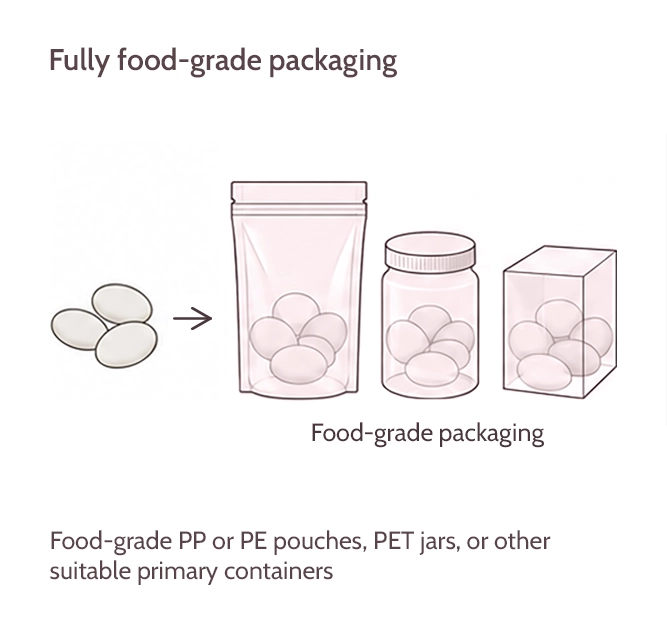
Only materials suitable for direct food contact should touch the dragées. Regulatory systems such as the EU framework require food-contact materials to be sufficiently inert so that they do not transfer substances to food at unsafe levels or cause unacceptable changes in its composition, taste, or smell.8European Parliament and Council. Regulation (EC) No 1935/2004 of 27 October 2004 on materials and articles intended to come in contact with food.View source
Uncoated decorative paper, cardboard, or ordinary metal surfaces should therefore not be treated automatically as suitable direct-contact packaging. Paper and board in particular can show grease staining when lipids migrate into fibrous packaging, producing an unattractive result even where the food itself remains acceptable.
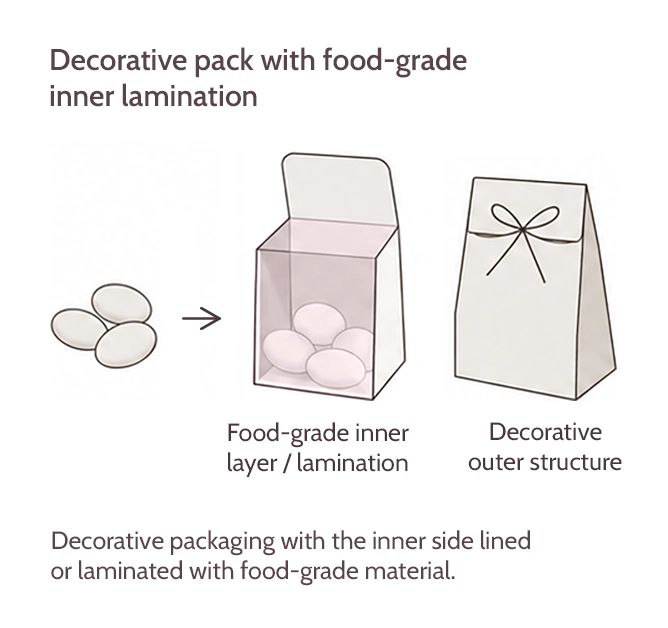
Where paper or cardboard forms part of the primary package, EL KAISSI recommends an appropriate food-grade barrier or lamination, such as a suitable PP layer or equivalent food-contact material, between the dragées and the absorbent substrate. Decorative metal packaging should likewise use a suitable food-contact coating or liner rather than leaving the product in contact with an unsuitable untreated surface.9European Parliament and Council. Regulation (EC) No 1935/2004 of 27 October 2004 on materials and articles intended to come in contact with food.View source
This distinction is important because a material being attractive, rigid, printable, or widely used for gift packaging does not in itself make its inner surface suitable for direct food contact.

Barrier performance also affects the condition in which the customer receives the product. Packaging should limit exposure to air, moisture, odors, and light as far as reasonably possible for the format being used.
Transparent windows and clear containers remain commercially useful because dragées are highly visual products, but transparency creates a trade-off. The product becomes easier to see while its exposure to light increases. Colored sugar-coated dragées placed in transparent packaging therefore require particular care in storage and display because the package itself no longer shields the colors from illumination.
Pack size should also correspond to how the product will actually be used. Smaller retail packs generally turn over more quickly, while larger packs may be appropriate for hospitality, events, corporate gifting operations, or customers consuming larger quantities. The useful question is whether the quantity is appropriate for the sales or consumption pattern rather than whether a larger package can physically accommodate more product.
Building Labelling Into the Pack
When dragées are packed under a retailer’s, distributor’s, or customer’s own name, labelling should be considered while the package is being developed rather than added after the visual design has already been completed.
Exact requirements differ by destination market, but they commonly include the name of the food, ingredients, allergen information where applicable, net quantity, lot identification, required date marking, relevant storage information, and other mandatory particulars.10Codex Alimentarius. General Standard for the Labelling of Prepackaged Foods, CXS 1-1985.View source
Leaving these requirements until the end of the design process often creates predictable problems: insufficient space, text that has to be reduced excessively, or an otherwise coherent package interrupted by information for which no proper area was planned.
Where several varieties are sold together, the label must also describe the actual assortment rather than only the most prominent component.
Packaging design, technical information, and regulatory compliance are therefore best developed together.
Managing the Retail Display
Display quantities should reflect actual turnover because the product outside its protective storage environment is exposed to more light, more handling, and often greater environmental variation than sealed stock.
Loose displays are better protected in covered containers than in permanently open ones, while smaller quantities can be replenished from correctly stored stock as sales require. A generous visual presentation does not require putting the full inventory on display. Smaller vessels, packaged examples, coordinated color arrangements, and regular replenishment can communicate abundance and range while leaving most of the stock protected.
Light exposure remains especially important for colored sugar-coated products. Display lighting may not generate enough heat to affect temperature significantly and can still degrade color over time. Windows and artificial lighting should therefore both be treated as sources of light exposure rather than considering only direct sunlight or hot lamps.
Displays should also be kept away from direct air-conditioning drafts and other locations where the product can experience sharper temperature fluctuations than the surrounding room.
The visual effect of the display should nevertheless be considered carefully. Glossy surfaces reflect their surroundings strongly, matte finishes produce a quieter appearance, and pearlescent finishes can produce highlights that change with viewing angle and illumination. The aim is to show these characteristics without subjecting the products to more light than necessary.
Preserving Quality Through the Entire Retail Cycle
Preserving dragée quality depends on continuity from the moment a delivery is received until the product is sold or served. Correct storage cannot fully compensate for poor handling later, just as careful display cannot restore a product that has already spent too long under unsuitable conditions. Stock planning, rotation, environmental control, handling, packaging, and display work together because each stage determines the condition in which the product enters the next.
Maintaining that continuity helps preserve the qualities built into the dragée during manufacture: the crispness and integrity of the shell, the condition of the chocolate surface, the consistency of color, and the appearance expected from the finished product.
For dragées, presentation begins in storage.