

Selecting dragées professionally involves more than choosing an appealing flavor or color. The same product may be sold loose, packed under a retailer’s own brand, incorporated into chocolate or confectionery assortment boxes, presented at special events, served in hospitality, or selected for corporate gifting.
Each application calls for its own balance of taste, texture, size, color, finish, formulation, presentation, and price. A dragée that works beautifully in a loose retail display may not be the best choice for a small branded package; one that pairs naturally with pralines in a gift box may not suit the visual language of a formal event.
There is therefore rarely one dragée that is simply “better” than another. The more useful question is whether its structure and character suit the clientele, the way it will be presented, the products around it, and the price position it is expected to occupy.
Begin with the Application
A dragée selected for loose retail does not have to perform in exactly the same way as one intended for a small branded package or a composed gift box.
When sold loose, the product itself becomes a principal part of the display. Color, finish, uniformity, and appearance in quantity matter alongside flavor and texture. A dragée that looks refined as a single piece should still present well when displayed in quantity.
In a retailer’s own packaging, size, shape, and surface finish interact with the pack itself. Smaller pieces can make a given net weight appear more generous; transparent windows and jars expose finish quality more clearly; delicate surfaces may demand greater care during handling and packaging.
In gift boxes and confectionery assortments, dragées become part of a broader composition. Their flavor, size, texture, and color should work with chocolates, pralines, truffles, marzipans or other premium confections. For weddings and other events, the brief may extend to a precise palette, a symbolic role, or coordination with the wider presentation.
The application establishes the context for the product’s evaluation, which can then follow the criteria that most strongly define it: center, coating, flavor, texture, size, color, finish, and price.
Choosing the Center
The center establishes much of a dragée’s underlying character. Identifying it as almond, hazelnut, pistachio, or chocolate is only the beginning; quality, preparation, and proportion can produce very different results within the same category.
Nut Centers
With nut-centered dragées, cultivar, origin, caliber, moisture, and fat content can all influence flavor, firmness, and the response to processing. This is particularly visible in Jordan almonds, where the almond remains clearly identifiable beneath a relatively simple sugar shell. At EL KAISSI, Spanish Largueta almonds are preferred for more refined Jordan almonds,1Calle, A. Aparicio-Durán, L., Batlle, I., et al. “Review of agronomic and kernel quality traits of 273 almond cultivars.” Genetic Resources and Crop Evolution, 2025View source while carefully selected California almonds provide a strong alternative for more accessible price positions. The distinction is not purely geographical: the almond’s variety and size both affect the finished dragée.
Preparation also matters.2Vickers, Z., Peck, A., Labuza, T., & Huang, G. “Impact of Almond Form and Moisture Content on Texture Attributes and Acceptability.” Journal of Food Science, 2014View source EL KAISSI uses several profiles according to the intended result: controlled soft drying to preserve a largely raw almond character; gentle or slow roasting for light development; regular roasting for a fuller roasted profile; and praline-style gentle toasting, in which selected nuts are lightly roasted during sugar caramelization.3Massantini, R. & Frangipane, M.T. “Progress in Almond Quality and Sensory Assessment: An Overview.” Agriculture, 2022, 12(5), 710View source
For the buyer, these differences should be tasted through the finished product. Is the nut crisp and fresh? Does its flavor remain distinct after the coating breaks? Is the roast appropriate to the sweetness or richness around it? A more expensive center is worthwhile when its quality remains perceptible in the final dragée; if the coating overwhelms it, the specification may not be adding meaningful value.

Chocolate Centers
Chocolate centers call for a different comparison. Their character begins with the cocoa: origin, fermentation, roasting, and blend all influence the flavor eventually expressed in the chocolate.4Santander Muñoz, M., Rodríguez Cortina, J., Vaillant, F.E., & Escobar Parra, S. “An overview of the physical and biochemical transformation of cocoa seeds to beans and to chocolate: Flavor formation.” Critical Reviews in Food Science and Nutrition, 2020, 60(10), 1593–1613View source Formulation then determines the balance of cocoa content, sugar, and, where applicable, milk solids.
Cocoa percentage alone is therefore a poor shortcut for chocolate grade.5Codex Alimentarius. “Standard for Chocolate and Chocolate Products, CXS 87-1981View source Two dark chocolates with the same percentage can differ markedly in bitterness, acidity, sweetness, and intensity. The useful question is how the chocolate performs inside the dragée: whether its flavor remains distinct, its sweetness is balanced, and its texture works with the surrounding shell.
Chocolate centers can also incorporate finely ground roasted nuts or take softer forms such as gianduja, praliné, or ganache-style fillings. EL KAISSI uses ground roasted almond or hazelnut in selected Easter dragées, while its Chocolate Mushrooms combine a soft chocolate-cream center with chunks of roasted hazelnut.
When sampling, consider the complete sequence of the bite: outer layer, transition, and center. That progression often reveals more about the quality and suitability of a dragée than its ingredient name alone.
Choosing the Coating
The coating determines how the center is encountered. It establishes the first texture, contributes sweetness or chocolate intensity, and controls the transition into the center.
A fine hard-sugar shell brings the center forward quickly and gives a clean, crisp bite. A heavier sugar coating gives more prominence to sweetness and crunch. With chocolate-coated nuts, the quantity and character of the chocolate determine the prominence of cocoa flavor, sweetness and melt before the nut emerges. Double-coated products add another layer to that sequence, combining chocolate with an outer sugar shell.
For the buyer, the important comparison is the coating architecture: material, thickness, number of layers, and proportion of center in the finished product (center / total ratio). Cutting samples in half is often revealing. It shows whether the coating supports the center or dominates it, and whether the construction feels deliberate.
The intended use should guide the choice. A Jordan almond for a formal event may benefit from a fine, precise shell that preserves the almond’s presence. A chocolate-coated hazelnut for premium retail can carry a more generous chocolate layer, provided the nut remains distinct. A double-coated almond may be appropriate when both a colored sugar finish and a fuller chocolate experience are desired.
Flavor and Pairing
A dragée should be tasted on its own, but when it will be served with other confections, it should also be judged alongside them.
A dark-chocolate almond can introduce cocoa intensity, roast, and crunch beside softer milk-chocolate pralines. Pistachio adds a distinctive nut character. Fruit profiles can bring acidity and brightness to a selection dominated by chocolate and nuts. Texture can be used in the same way: a crisp dragée can provide useful contrast in a box rich in soft ganaches and pralines.
The strongest pairing is not necessarily the most elaborate. What matters is whether the dragée adds something the surrounding selection needs: contrast, harmony, freshness, crunch, color, or a complementary flavor.
Color and Finish
Color is one of the most visible selection criteria, but it should be judged in its final setting. A shade can behave differently in a loose display, inside a branded package, beside chocolates in a gift box, or under event lighting. Exact color repetition is not always necessary; tonal relationships and controlled contrasts can create a more refined composition than forcing every element into the same hue.
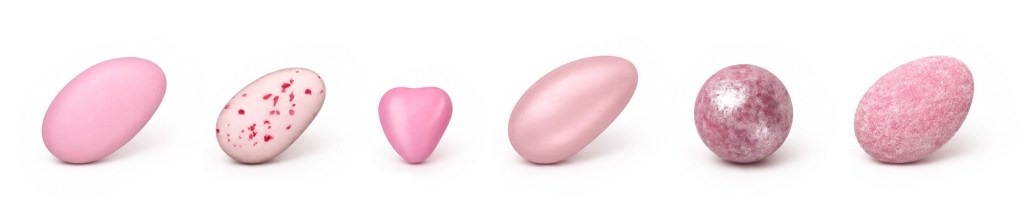
Finish changes the effect further. Gloss gives stronger reflections and visual intensity; matte surfaces are quieter; pearlescent finishes add depth; metallic finishes create stronger points of emphasis. The same color can therefore produce a very different impression according to its surface treatment.
Where color and finish are central to the brief, samples should be viewed with the intended packaging or presentation materials whenever possible.
Selecting Within the Right Price Position
Price is part of the specification, not a separate question asked after the product has been chosen.
The most elaborate option is not automatically the most appropriate if it pushes the finished product beyond the intended consumer price range, package cost, or event budget. A professional buyer should identify which characteristics create real value for the intended clientele and which can be adjusted without compromising the concept.
A Spanish Largueta almond may justify its additional cost when the almond itself is central to the proposition. In another application, a carefully selected California almond may provide a more appropriate balance between quality and target price. The same reasoning applies to chocolate specification, coating ratio, additional layers, flavors and decorative finishes.
Price should also be considered in the form in which the product will actually be sold. Loose retail may be driven by price per kilogram; a branded pack by net weight, piece count, and packaging; a gift box by the value of the complete assortment; an event by cost per favor, guest or finished presentation.
When a preferred specification exceeds the target, the useful response is not simply to choose something cheaper. It is to preserve the characteristics that matter most and identify the next best alternative within the intended price range.
Narrowing the Selection
Once the main criteria are defined, professional buyers can use the EL KAISSI Interactive Product Selector to refine their search through the portfolio by Category, Center, Coating, Finish, Color, and Flavor, combining several criteria to reach a more relevant selection.
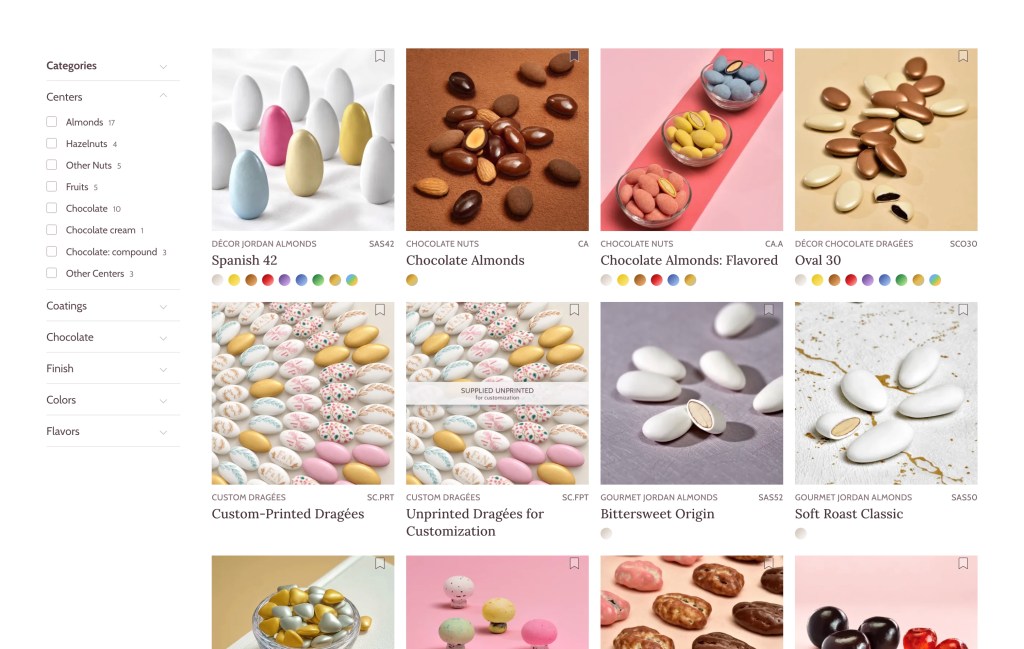
The most efficient approach is to begin with non-negotiable requirements, center and coating for example, then refine the results using whichever combination of the remaining filters best fits the brief. The resulting shortlist can then be compared through sampling and price, while taking into account practical requirements such as minimum order quantities, availability, lead times, and customization options.
Bringing the Selection Together
Selecting dragées professionally is an exercise in balance. Center and coating define the structure; their proportion shapes the bite; flavor determines how the product stands alone or pairs with others; color and finish connect it to packaging and occasion; and price determines which specification makes commercial sense.
Not every specification needs to be maximized. The strongest selection is the one in which the qualities that matter most are clearly present, unnecessary complexity has not been allowed to inflate cost, and the finished dragée makes sense for the clientele for whom it is being chosen.
Put these criteria into practice with EL KAISSI Interactive Product Selector.