

Dragées are among confectionery’s most enduring traditions. The term refers to a confection built around a center that is gradually coated with layers of sugar, chocolate, or another confectionery coating until the desired structure, texture, and finish are achieved.
The word dragée is French, pronounced roughly drah-ZHAY, with the g taking the “zh” sound heard in measure. The term appears in medieval French as dragie and is generally traced through Latin tragemata to Greek tragēma, referring to a dessert, sweet, or something to nibble.1Académie française. “Dragée.” Dictionnaire de l’Académie française, 9e éditionView source By the eighteenth century, French dictionaries were already using dragée for seeds or small dried fruits covered in hardened sugar—very close to the classic confectionery meaning it carries today.2Académie française. Dictionnaire de l’Académie française, 4e édition (1762), “Dragée.” ATILFView source
One of the best-known traditional examples is the Jordan almond, a whole almond enclosed in a hard sugar shell and long associated with weddings and celebrations. Today, however, the category extends far beyond sugared almonds. Modern dragées can be made with nuts, dried fruits, coffee beans, cereals, and other centers, with coatings ranging from hard sugar shells to chocolate, flavored layers, and decorative finishes.
Many dragées are built around nuts, particularly almonds, because they naturally provide crunch, structure, and flavor balance. Other centers can include hazelnuts, pistachios, dried fruits, coffee beans, cereals, or soft fillings, depending on the style of confectionery being produced. What unites these varied forms is not simply the center, but the controlled coating process that transforms it.
How Are Dragées Made?

Why the Center Matters

The Importance of Balance
High-quality dragées depend on balance between several elements: the center and its coating, sweetness and flavor, crunch and smoothness, appearance and use.
A coating that is disproportionately heavy can overwhelm the center, while the structure and thickness of the shell must suit the type of dragée being produced. A traditional crystallized sugar shell is inherently firm, whereas chocolate and softer coatings call for a different textural balance. Sweetness, too, must support the character of the center rather than obscure it. Even the surface finish needs to suit the product and the way it will eventually be presented.
For this reason, dragée production is less straightforward than the basic idea of coating a center might suggest. Consistency depends on controlling many small variables throughout the process, from the preparation of the center and the development of each coating layer to temperature, drying, texture, and final finishing.
From Jordan Almonds to Modern Dragées
Jordan almonds remain one of the most recognizable forms of dragée. Traditionally made from whole almonds coated in a hard sugar shell, they have become strongly associated with weddings, celebrations, and ceremonial gifting across many cultures.
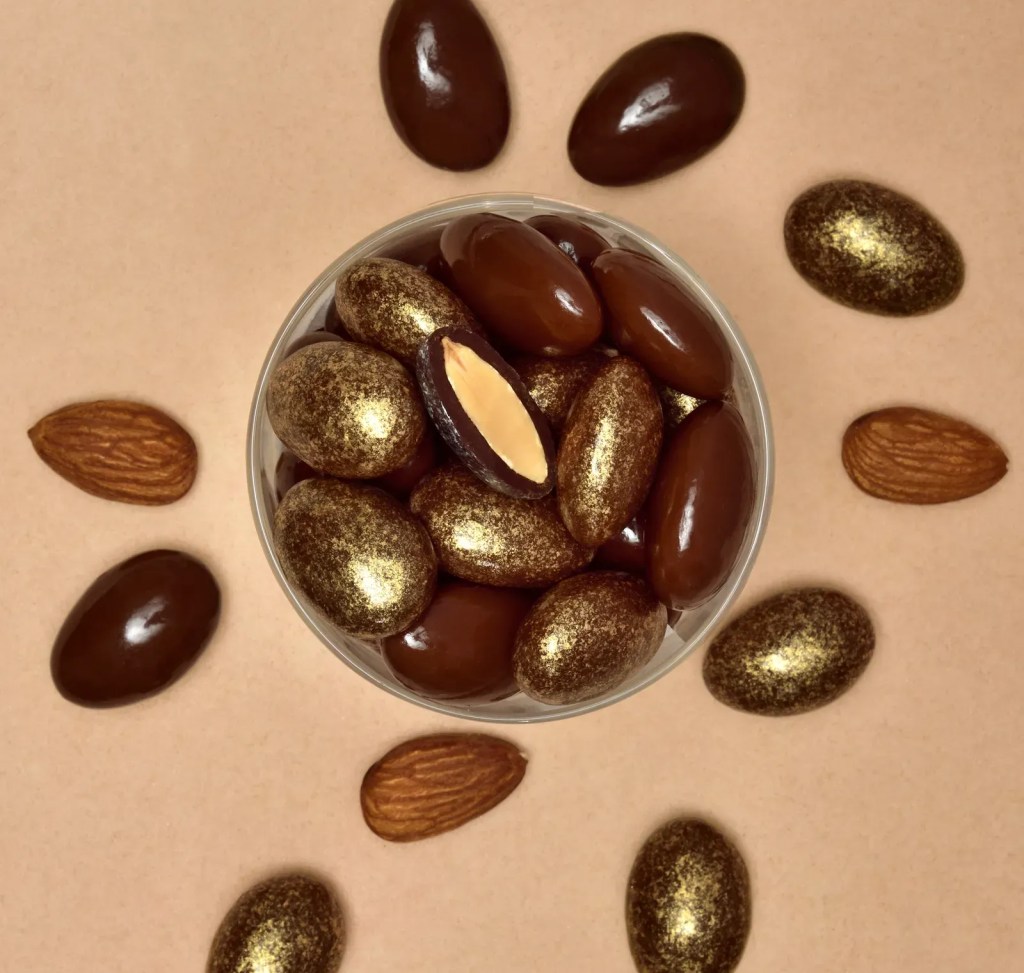
Over time, the category has developed in many directions. Chocolate-coated almonds and hazelnuts have become important dragée varieties in their own right. Sugar-coated chocolate centers introduced new possibilities for shape and color. Flavored coatings expanded the category further, while decorative treatments such as matte, glossy, metallic, pearlescent, and dusted finishes created a much wider visual vocabulary.
Modern production can also accommodate softer coatings, different center-to-coating ratios, customized colors and finishes, and no-added-sugar formulations. Despite this variety, the underlying principle remains remarkably consistent: a carefully selected center is gradually transformed through controlled coating into a finished confection with its own balance of flavor, texture, and appearance.
Why Dragées Remain Relevant
Dragées have endured because they occupy a distinctive place between confectionery and presentation.
They can be enjoyed as everyday chocolate-coated specialties, presented in premium retail packaging, served in hospitality settings, incorporated into wedding and event favors, or developed for seasonal and customized collections.
Their versatility comes from a simple principle capable of remarkably different interpretations. The center, coating, color, texture, flavor, and finish may all vary, while the underlying discipline remains the same: building the dragée gradually and bringing those elements into balance through controlled coating and careful finishing. From the traditional Jordan almond to contemporary chocolate and flavored varieties, dragées continue to evolve while preserving the technique and attention to balance that have defined the category for generations.